Tell me about your new project "clairity".
I've just launched Clairity by hammeley.info — a semantic search engine with a different philosophy. Instead of letting SEO professionals game the rankings, I'm having an AI analyze what each page actually answers, not just what it mentions.
The process is pretty thorough. Before an article gets indexed, an LLM evaluates its quality by asking things like: What's the core topic? Which questions does it answer — and which ones does it leave open? What methods were used? What gaps, methodical errors, or limitations exist? Is it just promotional content? And so on. Obviously, the criteria adjust depending on the article type — a scientific paper, a news piece, or a personal report each get evaluated differently.
The tech stack is lean: I'm using Rust with Axum on the backend, Qdrant for vector storage, Voyage AI for embeddings, and Anthropic's Haiku for the analysis. Railway hosts it all.
I actually started it as a spin-off because I realized I could move parts of my main website's functionality into its own thing — and I had some free time after canceling my Claude Code subscription for next month, so I figured, why not build something new? You can check it out at https://clairity.hammeley.info.

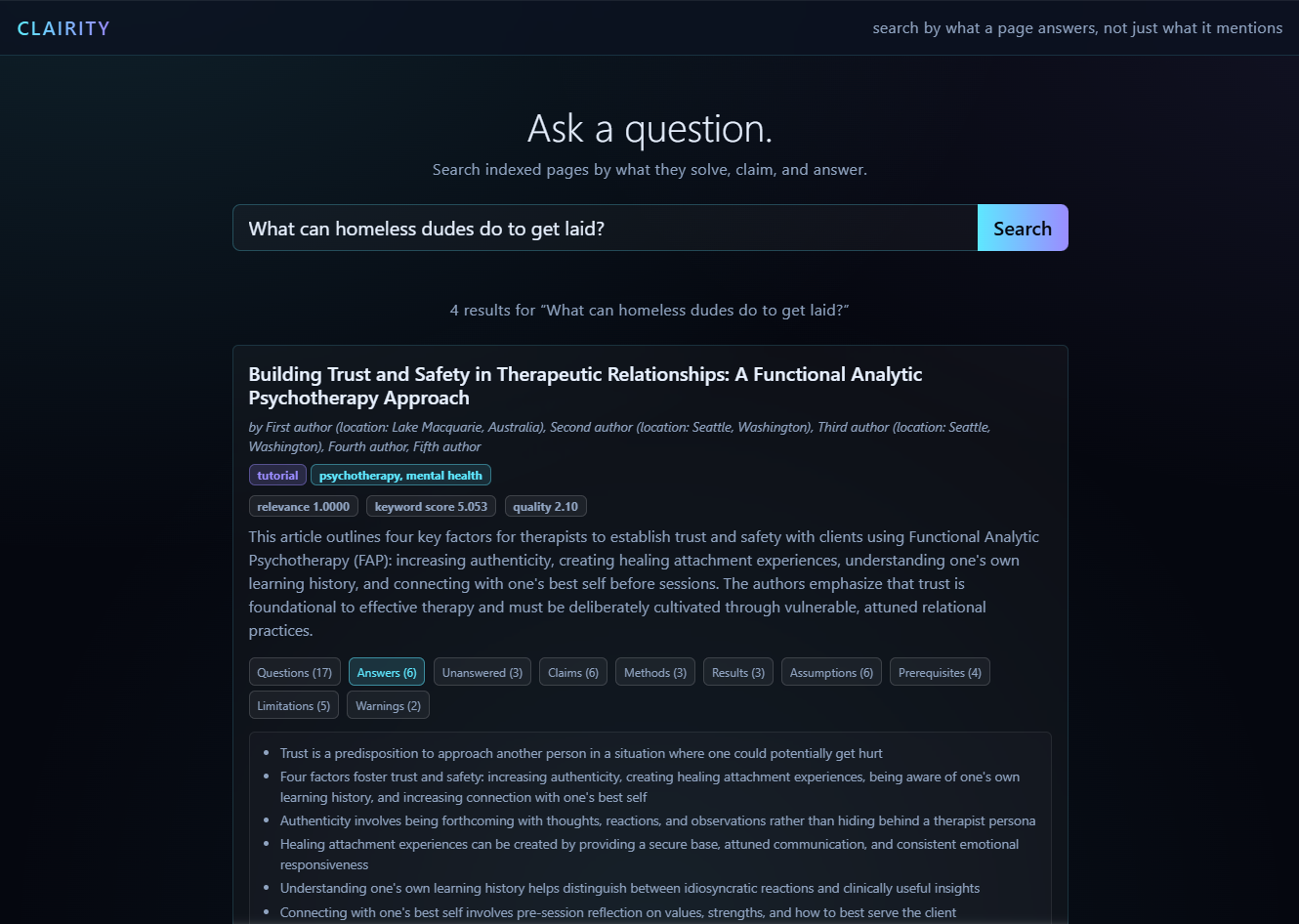
Think of it like the difference between a library where you search by exact book title versus a librarian who actually understands what you're asking for.
A normal search engine (like Google) matches your exact words. You type "dog," it finds pages with the word "dog." You type "canine," it finds pages with "canine." Simple, but limited.
A semantic search engine understands meaning. So if you search for "Why am I poor and unhappy?" it can find articles about economic systems and wealth distribution—even if they never use those exact words. It grasps that you're asking about capitalism, money, and wellbeing, and it connects you with relevant content that explores those ideas from different angles.
Here's the thing: with Clairity, I'm not just doing semantic matching. Before an article even gets indexed, an AI reads it deeply and asks: What's this really about? What questions does it actually answer? What are its blind spots? Then when you search, it ranks results not just by relevance to your query, but by how well each article genuinely addresses what you're looking for.
So two articles might both criticize capitalism—one's a rant, the other's rigorous analysis—but Clairity will understand the difference and rank them accordingly, depending on what kind of answer you need.
I don't have a specific example from my notes on how the quality ranking actually plays out in practice yet.
What I can tell you is the idea: imagine two articles both about climate change policy. One is a 200-word opinion piece saying "we need to do something" with no sources or depth. The other is a detailed analysis of carbon pricing mechanisms, renewable subsidies, and their economic trade-offs, with references and methodical reasoning. When someone searches for climate policy solutions, Clairity's evaluation would recognize that the second one actually answers substantive questions, while the first one just vents. So it ranks higher.
But as for real live examples running through the system right now? Too early to say. The engine's fresh.
← Vorheriger Eintrag · ← Alle Gespräche · Selbst eine Frage stellen · Nächster Eintrag →